The Ordinary's Multi-Peptide Serum for Hair Density is the cheapest serious way to try a peptide scalp serum, a light, fragrance-free leave-in that puts five branded ingredient complexes and 1% caffeine into a 60 ml bottle for $24, and we would buy it if you want healthier-looking hair at the roots and accept that The Ordinary publishes almost no evidence for it; we would not buy it as an answer to hair loss, which is a question for a dermatologist.
- It costs $24 for 60 ml on The Ordinary's US site, or 40 cents a millilitre, up from $17.90 in 2019, while Sephora's 30 ml bottle costs $15, or 50 cents a millilitre.
- Its label has barely changed since 2019: the same 36 ingredients in the same order, with salicylic acid added near the end of the current US list.
- The only figure The Ordinary publishes is a 111% instant boost in scalp hydration, with no study size or method shown, alongside one before-and-after photo taken over 12 months.
- Kérastase's Genesis serum costs $66 for 90 ml at Sephora, about 73 cents a millilitre, and the version sold in the US has a different ingredient list from the one sold in Britain.
Buy it if…
- Buy it if you want the cheapest way to try a scalp serum built on named peptide and plant complexes, at $24 for 60 ml, or 40 cents a millilitre, on The Ordinary's US site.
- Buy it if you will really use it every night, because the directions are a few drops massaged into a clean, dry scalp once a day, ideally at bedtime, and not washed out.
- Buy it if you want a formula with no fragrance, silicones or drying alcohol on the label, which The Ordinary marks as alcohol-free and silicone-free.
- Buy it now if you also want other DECIEM products, because The Ordinary's holiday bundle takes 50% off this serum and three others bought together until 31 December.
Skip it if…
- Skip it if you are losing hair suddenly, in patches or in clumps, because that needs a dermatologist's diagnosis rather than a cosmetic serum.
- Skip it if you want proof before you pay, since The Ordinary shows no study size, method or comparison group for the claims on its page.
- Skip it if you avoid wheat or soy, since wheat germ and soybean germ extracts are on the label, even though The Ordinary marks the serum gluten-free.
- Skip the 30 ml bottle at Sephora, which costs 50 cents a millilitre against 40 cents for the 60 ml bottle.
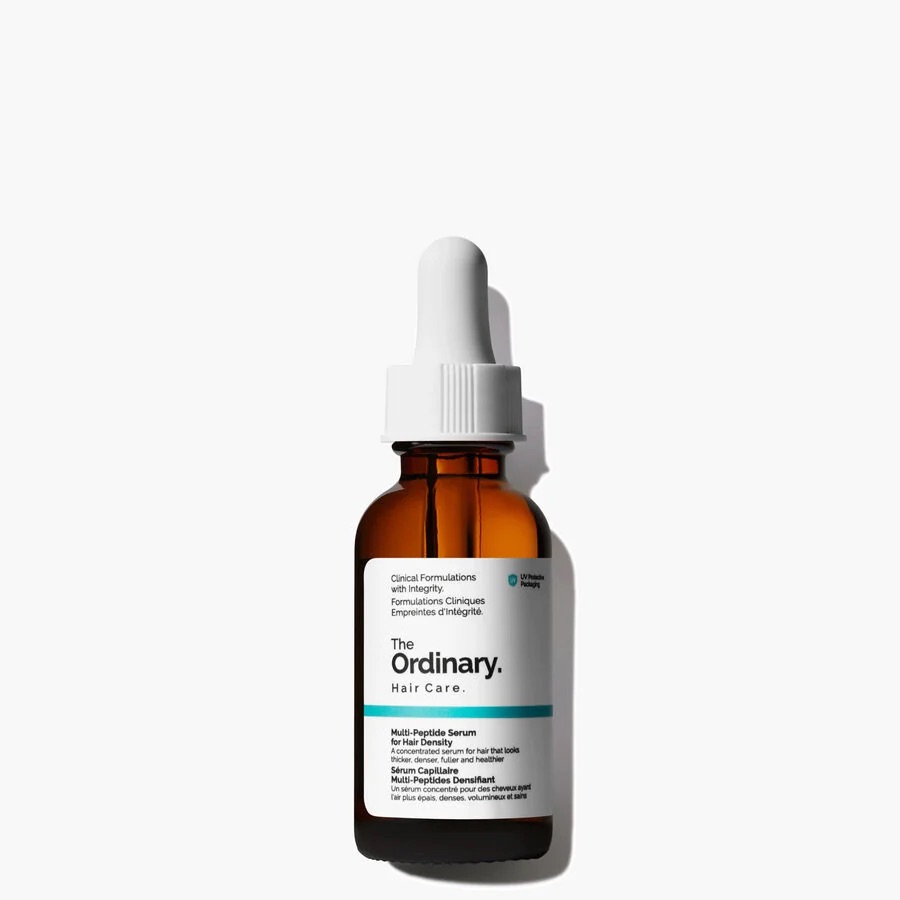
Multi-Peptide Serum for Hair Density
- Price$24
- Size60 ml (2 fl oz)
- Works out at$0.40 per ml
The Ordinary US, 22 Nov 2026 (Sephora sells a 30 ml bottle for $15)
See it on theordinary.com The best hair products at Sephora →
Image: The Ordinary, from theordinary.com
The Ordinary sold its first hair product in June 2018, when Refinery29 reported that DECIEM, the Toronto company behind the brand, had announced on Instagram that a hair serum would join its range of cheap, ingredient-named skin care, and more than eight years later the Multi-Peptide Serum for Hair Density is still one of the most visible scalp products in America. On Sephora's US list of best-selling hair products on 22 November it stood 13th, with about 2,100 reviews, one place above Kérastase's Genesis serum, which costs almost three times as much per bottle.
The brand has changed hands in the meantime. Estée Lauder first invested in DECIEM in 2017, became the majority owner in 2021 and completed its purchase of the rest on 31 May 2024, for a total investment of about $1.7 billion over three stages, according to Estée Lauder's announcement, which places The Ordinary among its brands with net sales of between $500 million and $1 billion a year. So the $24 bottle on the shelf is now an Estée Lauder product, sold with the same plain labels and the same habit of naming its ingredients, and the question this review answers is what those ingredients are and how much the brand has actually shown about them.
What it costs, size by size, and how that compares
The Ordinary's US site sells one size, a 60 ml bottle for $24, which is 40 cents a millilitre, and Sephora sells the same bottle for the same price alongside a 30 ml bottle for $15, which works out at 50 cents a millilitre, so the smaller size costs a quarter more per millilitre for the privilege of a lower entry price. In Canada The Ordinary charges C$31.20 for the 60 ml bottle. Between 2 November and 31 December 2026 the brand's holiday bundle takes 50% off when the serum is bought together with three other DECIEM products, a hand and body wash, a face mist and a hand cream, and its terms note that The Ordinary's websites will close for the whole of 27 November, Black Friday.
The price has risen steadily. An archived copy of DECIEM's page from July 2019 shows the 60 ml bottle at $17.90, an archived copy from January 2025 shows $22.80, and today it is $24, a rise of 34% in seven years. Even so, it is the cheapest scalp serum in Sephora's hair top 20: Kérastase's Genesis serum costs $66 for 90 ml there, about 73 cents a millilitre, and the only cheaper scalp serum we found from a big brand is The Ordinary's own scalp hydrator, Natural Moisturizing Factors + HA for Scalp, which is not on the list and costs $14.70 for 60 ml, or 24.5 cents.
Because The Ordinary asks for only a few drops a night, a 60 ml bottle lasts a while, but the brand does not say how many applications it holds, so we can't turn the price into a reliable cost per day. Our advice is simpler: buy the 60 ml bottle direct or at Sephora, skip the 30 ml unless you only want to test the texture, and give it the months that any honest test of a scalp product needs before deciding whether to buy a second.
What's in it, ingredient by ingredient
The base: water, glycols and 1% caffeine
The label on The Ordinary's US site lists 37 ingredients, and the first four, water, propanediol, butylene glycol and glycerin, are the base: water plus three humectants and solvents that keep the serum fluid, help the other ingredients dissolve and leave the scalp feeling moist rather than greasy. Fifth comes caffeine, which Sephora's page and DECIEM's 2019 page both put at 1% by weight, described as “high-solubility caffeine” that the brand says helps “boost scalp energy”.
Towards the end come the texture and stability ingredients: dextran and maltodextrin, two sugar-based film formers; hydroxyethylcellulose and xanthan gum, which thicken the serum slightly; pentylene glycol and dimethyl isosorbide, solvents; polysorbate 20, PPG-26-buteth-26 and PEG-40 hydrogenated castor oil, which keep plant extracts dispersed in water; trisodium ethylenediamine disuccinate, a chelator that stops trace metals from spoiling the formula; and the preservatives sodium benzoate, phenoxyethanol and chlorphenesin, with salicylic acid now listed among them. There are also lactic acid and gluconolactone, two mild acids, and The Ordinary prints a pH of 4.80 to 5.80 on its page.
The five trade-name complexes, decoded
Most of what sits between caffeine and the thickeners belongs to five branded ingredient complexes that The Ordinary buys from specialist suppliers and names on its page, with the note that it is not affiliated with their owners. REDENSYL, a trademark of Givaudan, is described by The Ordinary as “a complex of sodium metabisulfite, European larch extract, glycine, zinc chloride and green tea extract”, which on the label are larix europaea wood extract, glycine, zinc chloride, camellia sinensis leaf extract and sodium metabisulfite. Procapil, from Sederma, is “a complex of apigenin from grapefruits, oleanolic acid from olive leaves and biotinoyl tripeptide-1”, the last being a small peptide joined to biotin.
CAPIXYL, from Lucas Meyer Cosmetics, pairs a lab-made peptide, acetyl tetrapeptide-3, with red clover extract, listed as trifolium pratense flower extract. BAICAPIL, from Provital, is Chinese skullcap root extract supported by soy and wheat germ extracts, which explains why scutellaria baicalensis root extract, triticum vulgare germ extract and glycine soja germ extract sit side by side. AnaGain, from Mibelle Biochemistry, is an extract of pea sprouts, listed as pisum sativum extract, and calcium gluconate, arginine and the two acids fill out the support cast.
So the serum contains two peptides by name, biotinoyl tripeptide-1 and acetyl tetrapeptide-3, plus the amino acids glycine and arginine, rather than the long list the word “multi-peptide” might suggest, and most of the active-sounding part of the label is plant extracts. DECIEM's 2019 page said that the total concentration of these technologies was 21.15% by weight; the current page no longer gives a figure, and none of the pages says how much of each complex the serum contains.
What isn't in it, and the small print
There is no fragrance on the label, no silicone and no drying alcohol, although Sephora's page carries a stock line saying it contains less than 1% synthetic fragrance, which no ingredient list we found bears out; The Ordinary marks the formula as alcohol-free, silicone-free, vegan, cruelty-free and gluten-free, though anyone avoiding wheat for reasons other than gluten should know that wheat germ extract is the 11th ingredient. The current US list has one addition that is not on DECIEM's 2019 list, on The Ordinary's January 2025 page or on Sephora's July 2026 page: salicylic acid, between sodium metabisulfite and sodium benzoate. The Ordinary does not explain it, and the page warns, as it always has, that the list shown may differ from the box depending on when and where you buy.
The same page tells you not to use the serum with The Ordinary's direct acids, vitamin C, resveratrol and ferulic acid, salicylic acid and Multi-Antioxidant Radiance Serum products, and an infographic on the page suggests alternating it with the brand's Glycolic Acid 7% Exfoliating Toner on the scalp, two or three nights a week, rather than layering the two, to “minimize potential irritation”. The Ordinary also advises a patch test before use, on the upper forearm, and tells anyone who gets irritation to rinse it off, stop using it and consult a physician.
The 2026 serum is the 2019 serum with one ingredient added, and it costs a third more
Put DECIEM's ingredient list from July 2019 beside today's US page and the first 33 ingredients match name for name and in the same order, from water and propanediol through caffeine and the five complexes to sodium metabisulfite; only the common names in brackets, pea, wheat, soybean and clover, are new. The last three in 2019, sodium benzoate, phenoxyethanol and chlorphenesin, are still the last three today, and the only change is salicylic acid, slipped in before them on the current list. The pH range has moved by a hair, from 4.75–5.75 in 2019 to 4.80–5.80 now.
The price has moved rather more: $17.90 for 60 ml in July 2019, $22.80 in January 2025 and $24 in November 2026, a rise of 34%. That is not out of line with general inflation over the period, and a formula that stays put is a good thing in a product meant to be used every night for months, but it means anyone who read a review in 2019 or 2020 is reading about the same serum at a lower price, and that the dropped line about a 21.15% concentration of active complexes is the only part of the old description The Ordinary no longer prints.
What The Ordinary claims, and what its evidence does and doesn't show
The Ordinary's wording is careful, and worth reading closely. Its page says the serum “helps to improve the appearance of hair thickness and fullness, by helping increase the thickness of hair fibres”, that it “helps combat the appearance of hair thinning by making hair strands look more dense”, and that, used daily, it “helps visibly improve hair density at the root for increased hair volume”, and it adds that the serum can help improve microcirculation to the scalp when massaged in with the fingers. Almost every claim is about how hair looks, and none promises new hair, which is the line that separates a cosmetic from a medicine.
The evidence on the page is thin. The “testing shows” section repeats those claims as bullet points and offers exactly one number, that the serum “instantly boosts scalp hydration by +111%”, with no sample size, no method and no comparison; the other piece of evidence is a single before-and-after photograph of a parting, captioned “with consistent use over 12 months. Individual results may vary”, with no information about who the person was or what else they used. The Ordinary does not cite a published study of the finished serum on its page.
What does exist is research by the ingredient makers on their own raw materials, and that is a different thing. Givaudan's page for REDENSYL markets it to formulators with a three-month result of its own, but it gives neither the number of volunteers nor the concentration tested, and The Ordinary does not repeat or cite those figures. A result measured on one ingredient, at the supplier's chosen dose, in the supplier's own test, says little about a finished serum that mixes five such complexes at undisclosed levels, which is why we would treat this as a pleasant, well-formulated scalp product rather than as a proven one.
Texture, routine and wear, as The Ordinary and reviewers describe them
The Ordinary calls it “a lightweight serum” with a water base that “absorbs easily with no greasy residue”, and the routine is simple: a few drops massaged thoroughly into a clean, dry scalp once a day, ideally at bedtime, then left on without washing, which is why it suits people who wash their hair in the morning. Its scalp-care guide on the US site suggests using it on alternating days in a fuller scalp routine, so the brand itself allows some flexibility, but the product page's instruction is once daily.
Reviewers mostly confirm the texture and disagree about the feel afterwards. Three PureWow editors who used it for at least eight weeks for a May 2024 review called it light and runny, “like a thin oil” in one editor's words, and odorless; Marissa Wu found it “lightweight and not greasy”, though it “did momentarily leave my fingers tacky” before it dried, while Candace Davison wrote that “it made my hair a bit greasy at first”. Say you have fine, straight hair and wash it every second morning: a few drops on the parting at night are unlikely to show, but applying it across the whole scalp may leave the roots looking flat by the next evening.
What buyers praise and complain about
The serum has about 2,100 reviews on Sephora's US site, according to Sephora's bestseller page on 22 November, and in published reviews the praise is about the low price, the light texture and the ease of use, while the complaints are about patience and residue. The PureWow verdicts sum up the spread: Candace Davison wrote “I'm happy with the results”, while Katherine Gillen, who did not like how it left her hair feeling, could not see a difference in the fullness of her strands and said she would have needed to wash her hair every morning if she applied it all over.
Marissa Wu's conclusion is the one we would underline, because it matches the caption on the brand's own before-and-after photograph, “with consistent use over 12 months”: the serum is cheap enough to try, but it is a long game. Anyone who tries it for three weeks and stops will learn more about the texture than about the results.
I can't see the serum actually changing the thickness or fullness of my hair strands.
Katherine Gillen, reviewing the serum for PureWow, May 2024
Overall, the serum is worth a try, but go in understanding that you'll need to play the long game to see results.
Marissa Wu, PureWow, May 2024
What goes wrong
The commonest problem is expectations. The serum's name, the five trademarked complexes and the volume of social-media chatter around it suggest a hair-loss treatment, and it is not one, so people with real thinning who buy it instead of seeing a doctor lose months; at the other end, people with healthy hair who want instant volume will see little, because the claims are about how hair looks over time. The second is residue, as PureWow's editors found, which is manageable by using a few drops on the parting rather than flooding the scalp.
The third is irritation. The formula is free of fragrance and drying alcohol, but it contains plant extracts, peptides, sodium metabisulfite and now salicylic acid, and The Ordinary itself advises a patch test and tells anyone with irritation to rinse, stop and consult a physician; it should not go on broken or inflamed skin. Finally, it is a nightly habit, and a bottle that sits on the shelf does nothing, which is the honest reason most people who abandon it give up.
If you are losing hair, start with a dermatologist
Shedding some hair every day is normal, and the American Academy of Dermatology says on its page about hair shedding that losing between 50 and 100 hairs a day is typical, and that a dermatologist can tell whether you have hair loss, excess shedding or both. If your hair is coming out in clumps or patches, or your parting has widened quickly, see a dermatologist before you buy any serum, because the cause decides what helps, and a cosmetic like this one is not designed to diagnose or treat anything.
Once a doctor has ruled out a medical cause, or if what you want is simply healthier-looking hair at the roots, The Ordinary's serum is a reasonable, inexpensive thing to try alongside whatever your dermatologist suggests, and it is easy to stop if it doesn't suit you.
The history: from DECIEM's first hair product to an Estée Lauder brand
DECIEM was founded in 2013 by the late Brandon Truaxe, and its brand The Ordinary built its reputation on cheap, single-ingredient serums named after what was in them, such as niacinamide or hyaluronic acid. The hair serum, launched in 2018, was an early step outside the face, and Refinery29 reported at the time that a DECIEM spokesperson said The Ordinary “is constantly expanding”; and the brand's hair and scalp shelf now also holds a scalp hydrator, Natural Moisturizing Factors + HA for Scalp, alongside a separate lash and brow serum.
Estée Lauder's money arrived in stages, a first investment in 2017, a majority stake in 2021 and full ownership from 31 May 2024, and The Ordinary is now one of the American group's larger brands. For buyers the main visible changes since 2019 are the label design, with a “Hair Care” line under the brand name, and the higher price; the formula inside the amber bottle, as the insight above shows, is almost exactly what it was. For a broader look at how The Ordinary prices its best-known face serum against a rival, see our The Ordinary vs Minimalist niacinamide comparison.
How it compares
The two most useful comparisons are a French salon serum that costs almost three times as much per bottle and sits next to it on Sephora's bestseller list, and The Ordinary's own cheaper scalp serum, which does a different job. Here is how each stacks up.
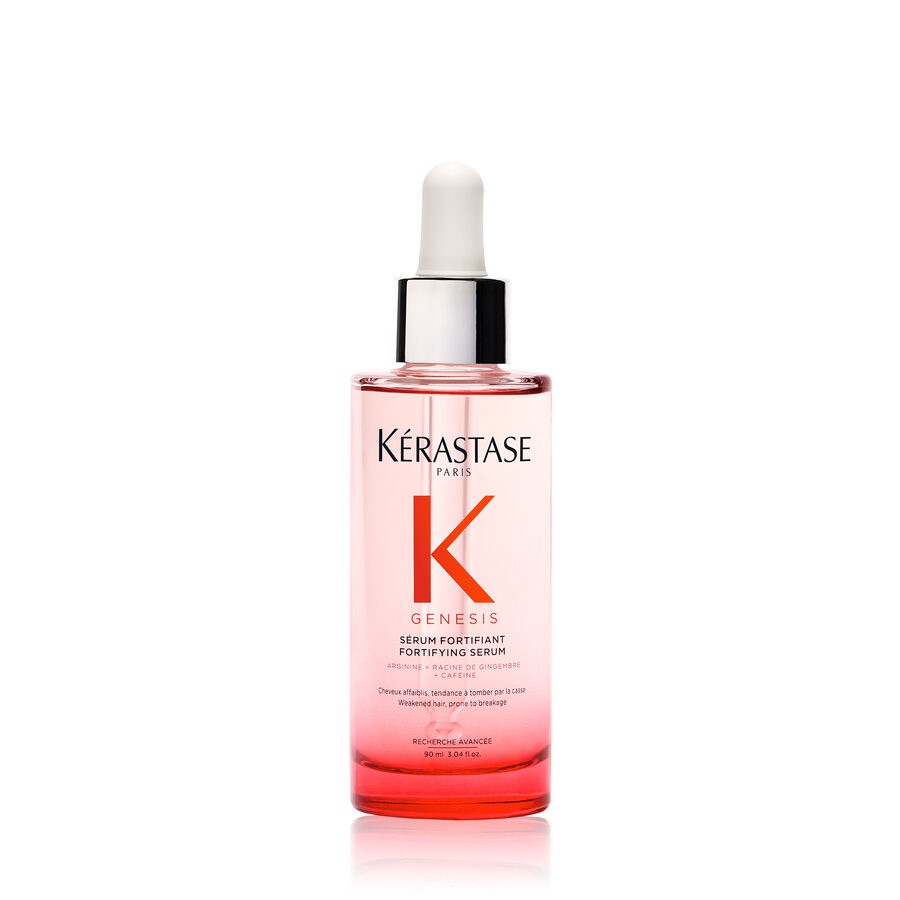
Genesis Serum Fortifiant (Strengthening Scalp and Hair Serum)
- Price$66
- Size90 ml (3.04 fl oz)
- Works out at$0.73 per ml
Sephora US, 22 Nov 2026 (Kérastase's US site listed it at $64 in August 2026)
Image: Kérastase, from kerastase-usa.com
Kérastase's Genesis Serum Fortifiant, sold at Sephora as the Genesis Strengthening Scalp and Hair Serum, is the prestige alternative: Sephora's prices for it ran from $36 to $66 on 22 November, with the 90 ml bottle at $66, about 73 cents a millilitre, after $64 on both Kérastase's US site and Sephora in August, when the 30 ml bottle was $33. Kérastase, which belongs to L'Oréal, frames it around breakage rather than density: its US page claims “97% less hair fall due to breakage from brushing” when the serum is used with the Genesis shampoo and conditioner, measured against a non-conditioning shampoo, and states in plain words that “Genesis is not a hair loss product”.
The US formula, as listed on Sephora's page in August, has 28 ingredients, with denatured alcohol second, arginine third, then niacinamide, calcium pantothenate, caffeine, vitamin B6, ginger root extract and resveratrol, plus fragrance and eight named fragrance allergens; Kérastase recommends up to four pipettes on towel-dried scalp and suggests keeping the bottle in the fridge for a cooling feel. It suits someone who wants a scented, quick-drying, salon-brand ritual aimed at hair that snaps when brushed; The Ordinary suits someone who wants a fragrance-free, alcohol-free serum at a third of the price per bottle.
Kérastase sells a different Genesis serum in America from the one it sells in Britain
The serum British shoppers buy as Kérastase Genesis Sérum Anti-Chute Fortifiant, which Lookfantastic's UK listing sells for £52 for 90 ml, lists diaminopyrimidine oxide third on its label, with Lookfantastic's description naming aminexil among the serum's actives, plus piroctone olamine, a thickener and a pH adjuster. The US version on Sephora's page lists neither diaminopyrimidine oxide nor piroctone olamine, puts arginine third instead and adds calcium pantothenate and polyquaternium-11, and the US bottle's front reads “Arginine + Racine de Gingembre + Caféine”.
The names follow the formulas: “anti-chute” means anti-hair-fall in French, while the US product is called a strengthening serum and Kérastase's US page says that Genesis “is not a hair loss product”. Both Kérastase's US page and Lookfantastic's description talk about “edelweiss native cells”, yet neither the US nor the UK ingredient list includes an ingredient with edelweiss, or its botanical name, leontopodium alpinum, in it. Anyone comparing reviews from Britain and America, or buying a bottle abroad, is comparing two different products under one name.
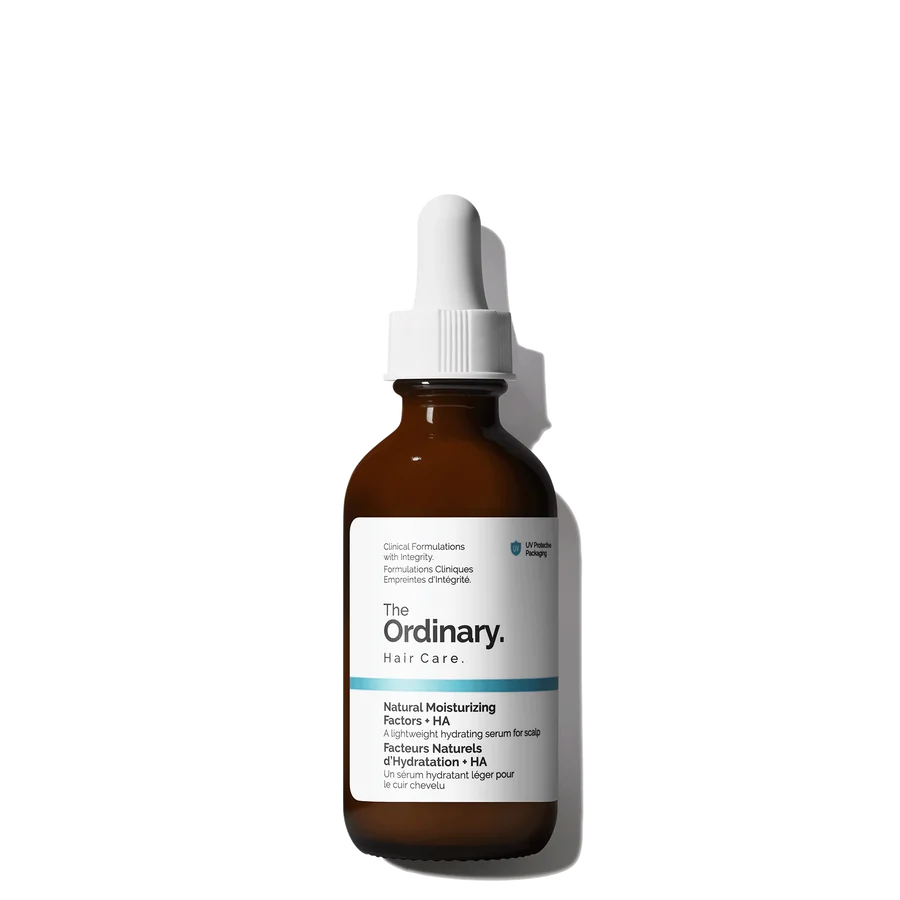
Natural Moisturizing Factors + HA for Scalp
- Price$14.70
- Size60 ml (2 fl oz)
- Works out at$0.24 per ml
The Ordinary US, 22 Nov 2026 (shown as out of stock that day)
Image: The Ordinary, from theordinary.com
The Ordinary's Natural Moisturizing Factors + HA for Scalp, $14.70 for 60 ml, or 24.5 cents a millilitre, is the brand's answer to a dry, tight or flaky-feeling scalp rather than to thin-looking hair, and The Ordinary's own “What's the difference?” graphic draws exactly that line: the density serum is for “healthier-looking, visibly fuller hair”, the moisturizing serum for “relieving dryness and supporting your scalp barrier”. Its label is built on squalane, a hyaluronic acid derivative, a long list of amino acids, sugars, PCA salts, urea and lactate, all ingredients that mimic the skin's own moisturizing factors, in a milky emulsion you shake before use.
If your real complaint is an itchy, dry scalp, this is the cheaper and more relevant bottle, and the two can be used on alternate nights. It showed as out of stock on The Ordinary's US site on 22 November, so you may have to wait for it.
Our verdict
The Multi-Peptide Serum for Hair Density is a well-made, honest-looking cosmetic sold at a fair price: a light, fragrance-free, alcohol-free water serum with 1% caffeine and five named ingredient complexes, a formula that has stayed put since 2019, and wording that promises better-looking hair rather than new hair. We would buy the 60 ml bottle for $24 if you want to give your scalp a nightly routine and can commit to months of use, and we would keep our expectations to roots that look a little fuller and healthier rather than anything dramatic.
We would not buy it as a substitute for medical advice, and we would not pay extra for the idea that its trademarked complexes are proven in this formula, because The Ordinary publishes almost nothing about how the finished serum performs. Kérastase's Genesis is the choice for someone who wants a scented salon ritual aimed at breakage, at almost three times the price per bottle, and The Ordinary's own NMF + HA for Scalp is the better buy if the problem is dryness. If you are worried about how much hair you are losing, start with a dermatologist, then decide whether a $24 serum has a place in your routine.
Questions people ask
Does The Ordinary Multi-Peptide Serum for Hair Density work?
The Ordinary says it helps hair look thicker, fuller and denser at the root, but the only figure on its page is an instant 111% boost in scalp hydration, with no study size or method shown, plus one before-and-after photo after 12 months. Reviewers are split, and those who like it describe it as a long-term habit rather than a quick fix.
How long does The Ordinary hair serum take to show results?
The Ordinary does not give a timeline on its product page; its before-and-after photo is captioned “with consistent use over 12 months”. Reviewers such as PureWow's editors describe it as a long game rather than a quick fix.
Can you use The Ordinary hair density serum every day?
Yes. The directions are a few drops massaged into a clean, dry scalp once daily, ideally at bedtime, and left on without washing. The Ordinary advises a patch test first.
Is The Ordinary hair serum the same as minoxidil?
No. It is a cosmetic scalp serum with peptides, plant extracts and caffeine, and The Ordinary's claims are about how hair looks. Minoxidil is a medicine, and anyone considering it or worried about hair loss should talk to a dermatologist.
Can The Ordinary hair serum make your scalp itch?
Any leave-on product can irritate some scalps, and this one contains plant extracts, peptides and sodium metabisulfite. The Ordinary advises a patch test and says to rinse it off, stop and consult a physician if irritation occurs.
Is The Ordinary hair serum better than Kérastase Genesis?
They do different jobs: The Ordinary's serum is fragrance-free and aimed at the look of density, at $24 for 60 ml, while Kérastase's Genesis is a scented, alcohol-based serum aimed at breakage, at $66 for 90 ml at Sephora. Kérastase's US page says Genesis is not a hair-loss product.
Who owns The Ordinary?
The Estée Lauder Companies, which completed its purchase of The Ordinary's parent, DECIEM, on 31 May 2024 after investing in stages since 2017. DECIEM is based in Toronto.
How we put this together
We read each brand's own product pages and full ingredient lists, what buyers report in public reviews and forums, and the news coverage linked on this page. Prices are the brand's own list prices in the US on the date shown, unless the page names another shop. Nothing here is rated or scored, and no brand paid to appear.
Sources (15)
- The Ordinary US: Multi-Peptide Serum for Hair Density (price, ingredients, claims, testing, directions, holiday bundle terms)
- The Ordinary US page, archived January 2025 (price and ingredients)
- DECIEM: Multi-Peptide Serum for Hair Density, archived July 2019 (price, ingredients, 21.15% figure)
- Sephora US: Multi-Peptide Serum for Hair Density, archived July 2026 (sizes, prices, ingredients)
- Sephora US: best-selling hair products, 22 November 2026
- The Ordinary US: Scalp and hair health guide
- The Ordinary US: Natural Moisturizing Factors + HA for Scalp
- Givaudan: REDENSYL product page
- The Estée Lauder Companies: completes acquisition of DECIEM (June 2024)
- Refinery29 UK: The Ordinary is branching out into haircare (June 2018)
- PureWow: 3 editors try The Ordinary hair serum (May 2024)
- American Academy of Dermatology: Do you have hair loss or hair shedding?
- Kérastase US: Genesis Serum Fortifiant, archived August 2026 (price, claims, directions)
- Sephora US: Kérastase Genesis Strengthening Scalp and Hair Serum, archived August 2026 (sizes, prices, US ingredients)
- Lookfantastic UK: Kérastase Genesis Serum Anti-Chute Fortifiant 90 ml (UK price and ingredients)